
Built-to-Last Heritage and Value at King’s Cross
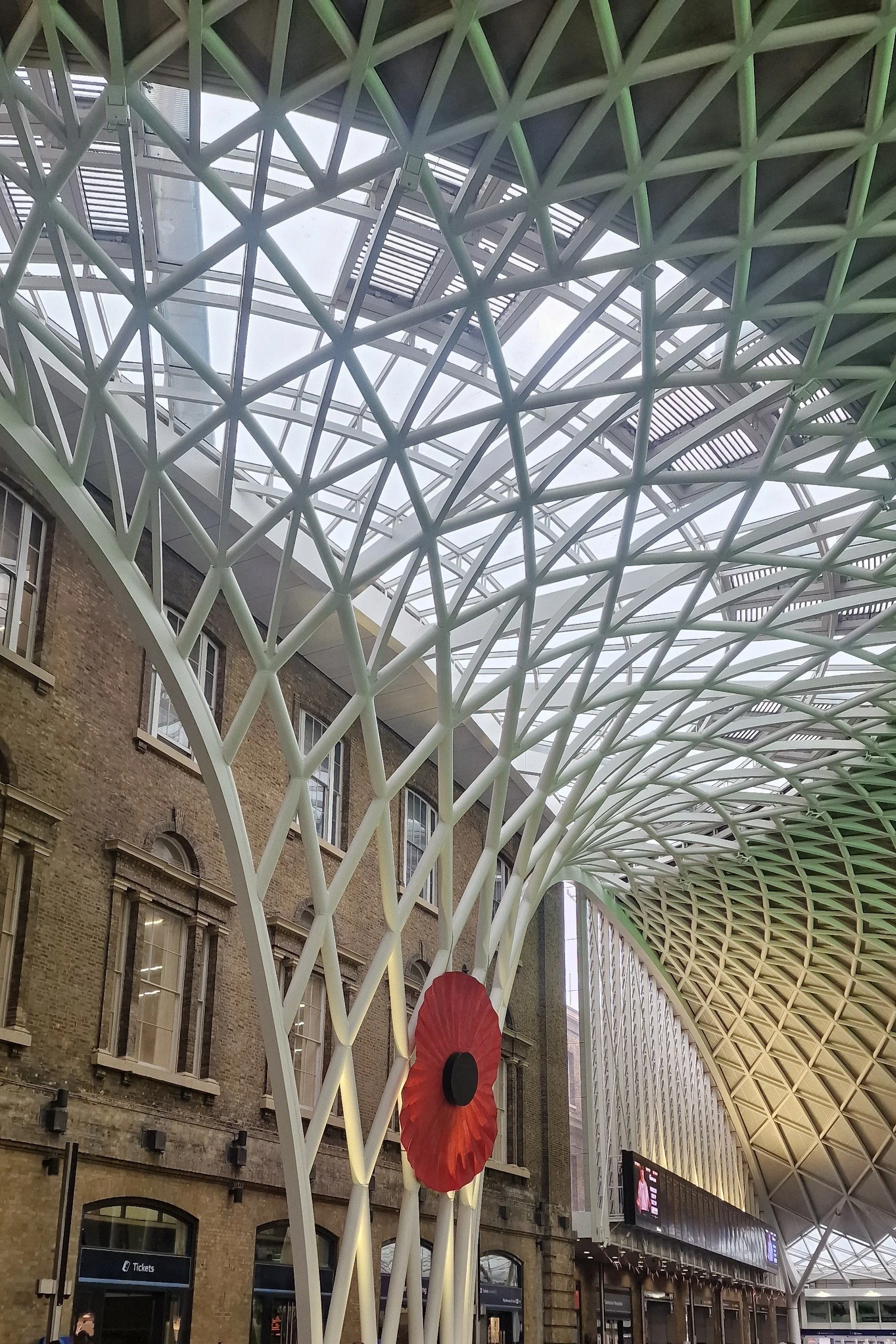
A poppy at King’s Cross – a reminder that when we respect the past, the places we build endure with purpose and value.
Few parts of London capture the balance between past and progress quite like King’s Cross. Once a landscape of soot-covered brick and disused sidings, it has become one of Europe’s most admired regeneration schemes a reminder that heritage, when handled well, can be both a cultural and an economic asset.
The 67-acre redevelopment has delivered over 2,000 homes, extensive public realm, and a mix of retail, workspace and cultural uses, all anchored by restored historic structures. Retaining and re-purposing the Victorian gas holders, the Granary Building and the former railway sheds has given the district an identity that new architecture alone could not achieve (King’s Cross Central Limited Partnership, 2025).
That approach has brought tangible results. Office rents at King’s Cross rose from below central London averages in the early 2000s to more than double within a decade of completion, outperforming comparable new-build districts (Centre for Cities, 2022). Residential values followed, supported by design quality, amenity and character. Heritage, once viewed as a constraint, became a differentiator, transforming the perception of the area and driving long-term resilience.
Yet replicating this success has become increasingly challenging. Build cost inflation has outpaced house price growth across much of London, tightening margins and placing pressure on schemes that involve complex conservation or bespoke design. Heritage retention often demands unconventional detailing, additional professional input and, at times, design compromise. The commercial balance therefore depends on early stage appraisal, precise cost planning and clear design leadership.
The lesson for planners, investors and development consultants is straightforward. Integrating heritage does not only preserve the past; it creates scarcity, identity and emotional connection, qualities that underpin long-term value. King’s Cross shows that respecting what was built before can still deliver modern schemes that stand the test of time.
---
References
Centre for Cities 2022, Learning from King’s Cross Regeneration, London. Available at: https://www.centreforcities.org Accessed 28 October 2025.
King’s Cross Central Limited Partnership 2025, Residential and Mixed-Use Development Summary, London. Available at: https://www.kingscross.co.uk Accessed 28 October 2025.